Civil authority, held directly
The arrangement Ahilyabai established after 1767 is unusual enough to be worth stating plainly: she retained the civil government of the Holkar territories in her own hands, while military command was exercised by Tukoji Rao Holkar.
This was not a nominal division. It meant that revenue, justice, public works and external correspondence ran through her, while campaigns and the maintenance of troops ran through him. Arrangements of this kind are fragile — they depend on both parties continuing to accept the boundary — and the fact that this one held for twenty-eight years is itself a significant administrative achievement.
It also shaped what her rule was for. A government whose head cannot lead armies is a government that must justify itself by what it does at home.

A later painted likeness. She is almost always shown seated, plainly dressed, and holding a staff — the iconography of a working ruler rather than a martial one.
The shape of a working day
Drawn from the consistent emphases of the sources rather than from any single surviving timetable. The sequence is indicative; the priorities it reflects are well attested.
Private observance
Accounts uniformly describe a day beginning with personal religious observance. Whatever else it was, it fixed an early and invariable start to the working day.
Papers and revenue
Correspondence, revenue statements from the districts, and the business arising from them. This is the part of her rule least visible today and most consequential at the time.
Open court
The durbar at which petitions were heard. The consistent emphasis in the sources is that she heard them herself, and that access was not restricted to people of standing.
Works and endowments
Instructions on construction and repair, and the settlement of endowments to maintain what had been built. A distinct and recurring category of her business.
Council and correspondence
Consultation with officers, and the letters that maintained relations with the Peshwa at Pune, with Tukoji Rao Holkar in the field, and with neighbouring powers.
The machinery of the state
Six functions that between them account for most of what her administration actually did.
Revenue
Assessment and collection across a largely agricultural territory. Her administration is credited with keeping demands at a level cultivators could actually meet — a policy with an obvious practical logic in a period when populations could and did move away from over-taxed districts.
Justice
A personally-heard appellate function sitting above local and customary dispute resolution. The significance lies less in any body of new law than in the reliability of access.
Security of routes
Roads and river crossings within and across the state, and the safety of the traders and pilgrims using them. Accounts describe agreements with hill and forest communities on the state’s margins, securing passage by settlement rather than by campaign alone.
Military command
Held separately by Tukoji Rao Holkar throughout her rule. The division of civil and military authority is one of the defining structural features of her government.
Public works
Construction and repair, and — distinctively — the endowment of maintenance funds so that completed works would continue to function without further central expenditure.
Relations with Pune
The Holkar state operated under the broad authority of the Peshwa. Managing that relationship without surrendering practical autonomy was a permanent requirement of the office.
Justice, and why it is the part people remembered
Of everything her administration did, the open court is what fixed itself in popular memory — and it is worth being precise about why.
In an eighteenth-century Indian state, most disputes were settled locally, by caste councils, village assemblies or revenue officers. That system worked reasonably well until one of the parties was powerful. At that point the only effective remedy was appeal to the ruler, and whether that remedy existed in practice depended entirely on whether the ruler could be reached.
The consistent testimony about Ahilyabai is that she could be. That is a modest-sounding claim, and it is the reason her name survived among people who had no interest whatever in the politics of the Maratha confederacy.
The measure of a court is not the law it applies but whether the weaker party can get into the room.
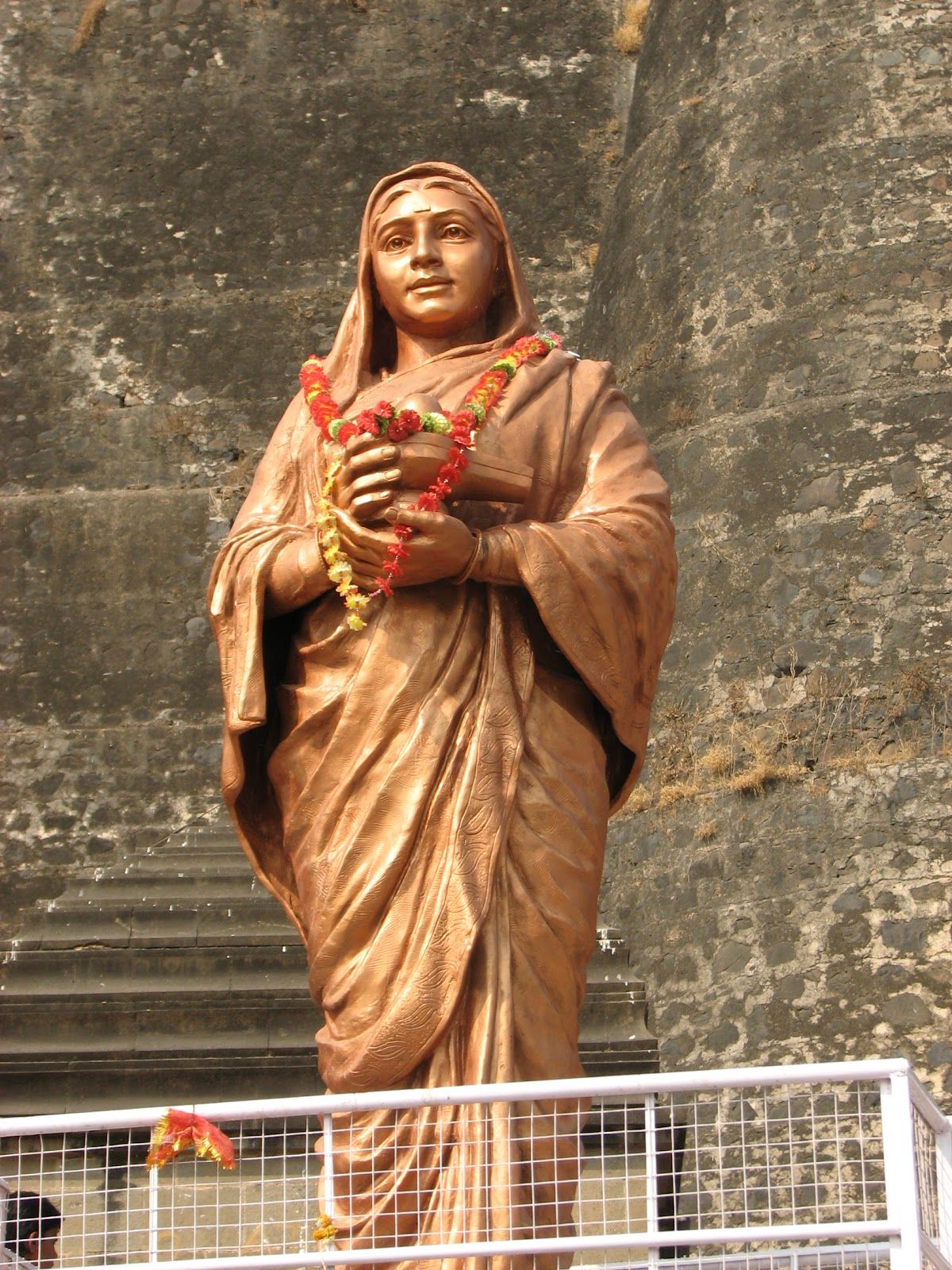
A modern commemorative statue. Public sculpture of this kind is a nineteenth- and twentieth-century phenomenon, and reflects later memory rather than contemporary portraiture.
Revenue, and the logic of moderation
A recurring judgement in accounts of her rule is that the Holkar territories were taxed at levels that cultivators could sustain, and that the state’s finances were nonetheless sound. Those two things are usually presented as a virtue. They were also, in the conditions of the period, straightforward economics.
Land in eighteenth-century central India was not scarce; cultivators were. A district assessed beyond what it could bear lost population to neighbouring territories, and a depopulated district yielded nothing at all. Rulers who understood this taxed moderately and grew their revenue base; rulers who did not extracted more for a few seasons and less thereafter.
Set beside her building programme, the pattern is consistent: sustained investment in the conditions that make a territory productive, rather than maximum extraction from it.
A note on sources. Assessments of Ahilyabai Holkar’s administration draw on a mixture of Maratha records, later chronicles and nineteenth-century British accounts, and these do not always agree on detail. The picture given here reflects the points on which they broadly converge. Specific figures for revenue, troop numbers or the count of works completed vary widely between sources and are not asserted on this site.
From administration to stone
What a government of this kind produced, and where you can still stand in front of it.