Sixteen questions
01 The essentials
Ahilyabai Holkar (1725–1795) was the ruler of the Holkar territories of Malwa in central India from about 1767 until her death. She held civil authority in her own right, governing from her capital at Maheshwar on the Narmada, while military command was exercised separately by Tukoji Rao Holkar.
She was born on 31 May 1725 at Chondi, a village in the Jamkhed area of present-day Ahmednagar district, Maharashtra. Her father, Mankoji Shinde, was the village patil — the headman responsible for revenue and local dispute settlement.
Through a sequence of deaths in the Holkar family. Her husband Khanderao was killed at Kumher in 1754; her father-in-law Malhar Rao Holkar died in 1766; and her son Male Rao, who succeeded him, died the following year. She then sought and obtained recognition of her own authority over the territories rather than allowing the administration to pass elsewhere.
She governed for roughly twenty-eight years, from about 1767 until her death at Maheshwar on 13 August 1795.
02 Her rule
For two things above all. First, an administration widely described as accessible and fair — she heard petitions in person, in open court, and taxed at levels cultivators could sustain. Second, a programme of temple building, restoration and public works that extended across the whole subcontinent, far beyond the territory she governed.
No. Military command throughout her rule was exercised by Tukoji Rao Holkar. The separation of civil and military authority was a defining structural feature of her government, and it held for the whole twenty-eight years.
A demonstration that a state could be governed effectively through administration and public investment rather than through territorial expansion — and a body of building work across India that kept a network of pilgrimage places physically usable at a time when many had suffered damage or the collapse of their endowments.
They are honorifics attached to her name. Lokmata means mother of the people; Punyashlok is a term of high moral and religious regard. Both belong to a religious and moral register rather than a political one, which reflects how her reputation was formed.
03 Places and buildings
Maheshwar, on the north bank of the Narmada, was her capital. She moved her seat there from Indore in about 1767 and governed from it until her death. The fort and palace, the stone ghats along the river, and the temples on the bank all date substantially from her period, as does the handloom weaving still worked in the town.
A recurring arrangement rather than a style: a temple, a ghat giving access to water, a well or tank, a rest-house, and a permanent endowment to maintain the whole. She built in the regional idiom wherever she worked, using local materials and craftsmen, which is a significant part of why so much of it survives.
The best-documented is the rebuilding of the Kashi Vishwanath temple at Varanasi in 1780. The Vishnupad temple at Gaya and a temple at Somnath are also attributed to her patronage, along with works at Omkareshwar, Ujjain, Dwarka, Nashik, Trimbakeshwar, Badrinath, Kedarnath, Gangotri, Puri, Rameswaram, Srisailam and Kanchipuram.
The handloom textile tradition established at Maheshwar under her patronage. Woven in cotton and silk, it is identified by its borders — geometric, frequently in metallic thread, and characteristically reversible. It is still worked in the town and remains a significant source of employment there.
04 Memory and sources
Because her reputation was built by the people who used what she paid for, across a very wide area and over several decades, rather than by court chroniclers. Modern commemoration is extensive: the university and airport at Indore carry her name, statues stand in towns across Maharashtra and Madhya Pradesh, and her birth anniversary is publicly observed. The tricentenary of her birth was marked in 2025.
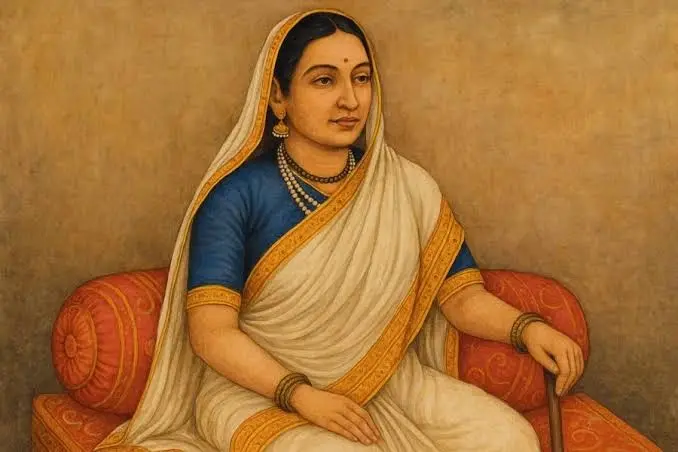
No portrait made from life is securely identified. The painted images widely reproduced — including those on this site — are later artistic representations, and devotional paintings express how she has been remembered rather than documenting events.
Some are documented and some are tradition, and this site keeps the two apart. The rebuilding of Kashi Vishwanath in 1780 is firmly established. The well-known accounts of her being dissuaded from sati in 1754, and of her refusing to exempt her own son from justice, appear in later sources rather than contemporary record. Our Stories & Anecdotes page sets out each one with its documentary status.
No verified figure exists. Numbers in circulation vary by an order of magnitude between sources, and this site does not reproduce them. The scale of the programme is better understood from its geography — it reaches every direction from Malwa — than from any count.
A note on sources. Where a question has no settled answer — the number of works she funded, the precise mechanics of her recognition as ruler, the historicity of particular stories — these answers say so rather than choosing a figure or a version.
Still looking for something?
The Knowledge Centre goes into more depth, and we are glad to hear from you directly.