The shrine
A temple built new, or an existing one repaired — the fixed point around which everything else is organised.
The buildings associated with Ahilyabai Holkar are not, for the most part, architecturally revolutionary. They are competent, durable, regionally idiomatic stone construction. Their significance lies in the programme rather than the individual building.

Look at enough of the sites associated with her and the same five elements keep appearing together. It is effectively a standard specification, applied from the Himalaya to the southern peninsula.
A temple built new, or an existing one repaired — the fixed point around which everything else is organised.
A ghat giving access from the shrine to the river, usable in every season and at every water level.
A well, step-well or tank securing a supply independent of the river itself.
A dharamshala for travellers, and frequently a kitchen alongside it.
Land or revenue settled permanently on the whole arrangement, to fund its upkeep and its staff.
The fifth element is the one that distinguishes the programme. Building is a single act of expenditure; endowment is a permanent one. Tying the two together is why so many of these sites were still functioning a century and two centuries later.
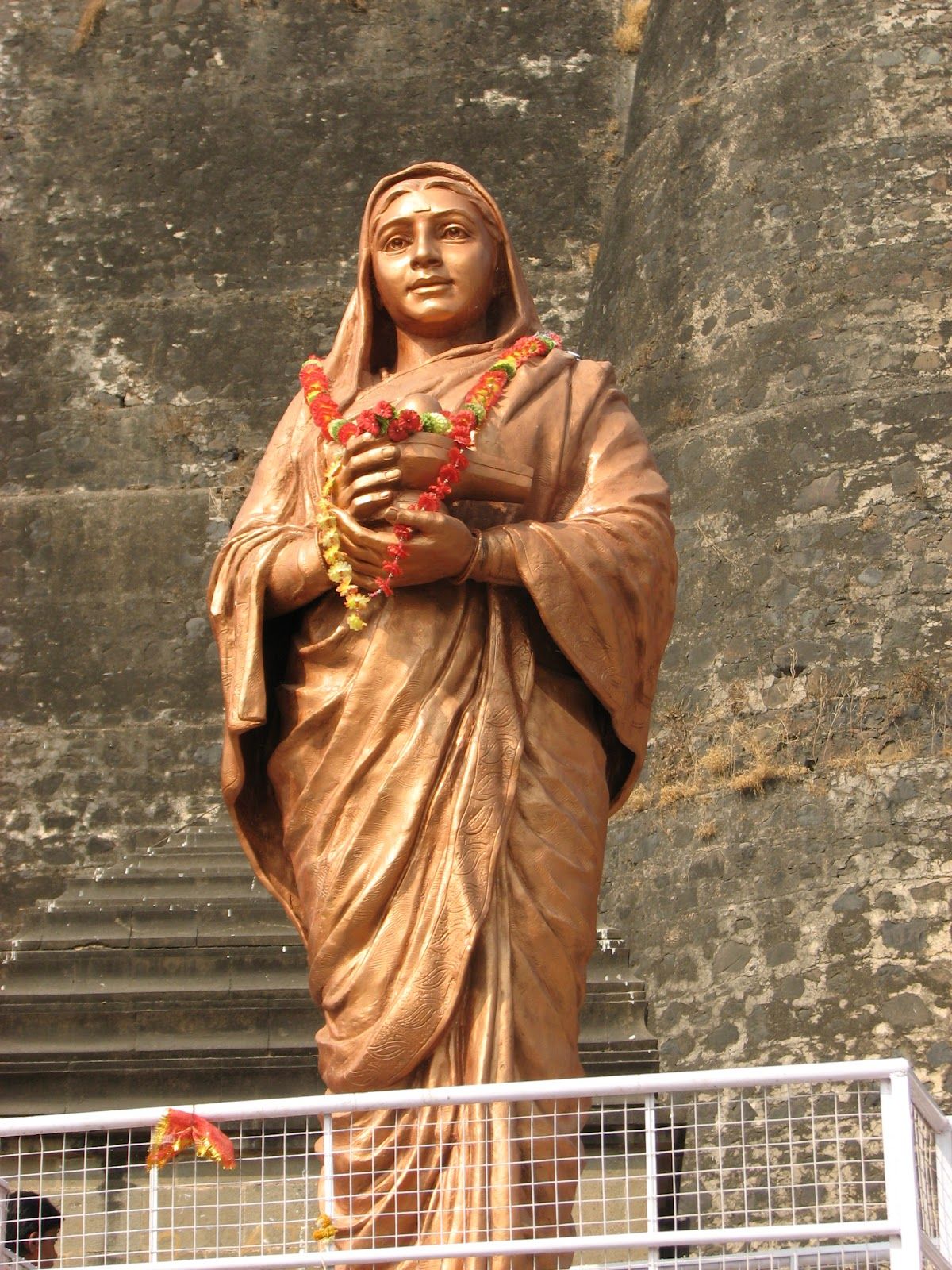
Commemorative sculpture set against the stonework of a fort — the material she built in, and the material she is remembered in.
One of the more revealing features of her building programme is what it did not do. A ruler constructing across a dozen regions could have imposed a single house style as a signature. Hers did not.
Work at a site in the Himalaya, on the Gangetic plain, on the Gujarat coast and in the Tamil country was carried out broadly in the local building tradition, using local materials and local craftsmen. The result is that her foundations sit inside their regions rather than announcing themselves against them.
Whether this reflects a deliberate architectural philosophy or simply the practical realities of eighteenth-century construction at a distance, the effect is the same: buildings that were accepted locally and maintained locally, which is a large part of why they survived.
If one building type belongs to Ahilyabai Holkar more than any other, it is the ghat — the broad flight of stone steps running down a river bank to the water.
Ghats are demanding structures. They must hold against the annual flood, remain usable as the water level moves through many metres over a season, carry heavy foot traffic, and be repairable. They are also, in a riverine religious landscape, the single most heavily used piece of public infrastructure there is.
She built and repaired them at Maheshwar on the Narmada and at sites on the Ganges, including the ghat at Varanasi that carries her name. The form recurs throughout her programme because it solves the problem her programme was chiefly concerned with: getting large numbers of ordinary people safely to water.
The Maheshwar riverfront is the fullest surviving expression of the idea — fort and palace above, temples along the bank, and a continuous sweep of steps below, worked as a single composition rather than as separate buildings that happen to adjoin.
A ghat is the point at which a state stops being an abstraction and becomes a place to put your feet.The Maheshwar riverfront
A great deal of it. The temples at Maheshwar and its ghats, the Kashi Vishwanath temple at Varanasi and Ahilya Ghat below it, the temple at Somnath she is credited with building, the Vishnupad temple at Gaya, and a long list of rest-houses, wells and shrines from Badrinath to Rameswaram.
Their condition varies enormously. Some are protected monuments; some are in continuous religious use and have been repeatedly modified; some have been rebuilt around; and some are known chiefly from record. Attribution is not always straightforward either — later repair and reconstruction can obscure what an eighteenth-century foundation originally looked like.
A note on sources. Attributions of specific structures to Ahilyabai Holkar’s patronage vary in how well they are documented. Some, such as the rebuilding of Kashi Vishwanath, are firmly established; others rest on local tradition. This site names sites that are widely and consistently attributed, and does not claim a complete or verified inventory.
The temples she rebuilt and endowed, and the places across India where her work still stands.