Three things, kept separate
Popular narrative about a figure like Ahilyabai Holkar accumulates for centuries. Discarding it would lose something real; repeating it as fact would be dishonest.
Every story below is therefore given in three parts: what is told, what is established, and what it signifies. Where the record is thin, the page says so.
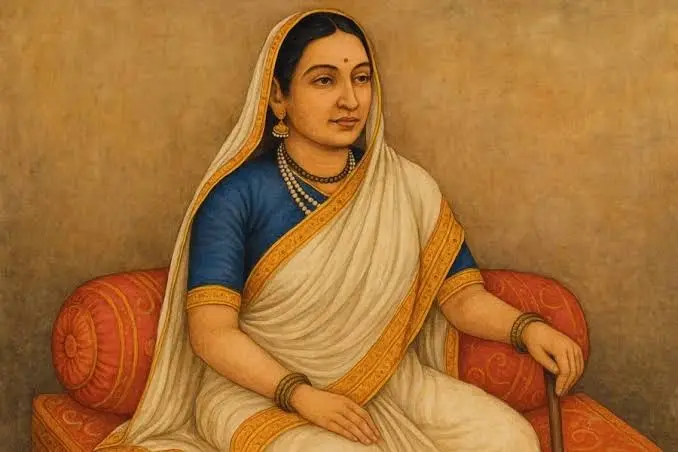
The decision not to burn
The most repeated story about her is also the one that determined everything else.
What is told
When Khanderao Holkar was killed at Kumher in 1754, Ahilyabai — then about twenty-nine — is said to have prepared to perform sati, and to have been dissuaded by her father-in-law Malhar Rao Holkar, who wanted her to remain and continue in the work of the state.
What is established
Khanderao’s death at Kumher in 1754 is well established, as is the fact that Ahilyabai remained within the Holkar administration for the twelve years that followed and emerged from them with a working command of its affairs. The episode of the dissuasion is recorded in later sources rather than in contemporary documentation.
What it signifies
Whatever happened in 1754, the outcome is not in question: a widow of twenty-nine stayed inside a working government and was trained in it by the man who had built it. Everything that follows depends on that.

The case she would not exempt
A story told to explain what her court was like — and told, pointedly, against her own family.
What is told
In the best-known version, a complaint is brought before her that her own son has caused the death of a calf by driving his chariot over it. Rather than set the matter aside, she insists that the same penalty be applied to him as would be applied to anyone else.
What is established
This narrative appears in later popular and devotional literature about her rather than in contemporary record, and it circulates in several incompatible versions. It should be read as a story told about her, not as a documented event.
What it signifies
Stories of this kind are not invented at random. They are told about rulers whose courts people believed were genuinely open, and they encode a specific claim: that her justice did not have a category of person it could not reach. That belief, whatever its factual basis in any single case, is itself part of the historical record.

A temple rebuilt after a century
The most consequential single act of her patronage, and the best documented.
What is told
In 1780 the Kashi Vishwanath temple at Varanasi was rebuilt at her expense, on a site adjacent to the one where the earlier structure had been destroyed in 1669.
What is established
The date, the patron and the building are all firmly established. The temple had stood unrebuilt for over a century in the most important pilgrimage city in northern India. The reconstruction was accompanied by wider works on the Varanasi riverfront, including the ghat that carries her name.
What it signifies
The act placed her name in front of pilgrims from every region of the subcontinent, and it has been read politically by contemporaries and by every generation since. It is also the clearest illustration of the strategy that ran through her patronage: acting at national scale through building rather than through arms.

The looms she brought to Maheshwar
A decision about court supply that turned into a two-hundred-year industry.
What is told
Ahilyabai settled weavers at Maheshwar and supported the production of fine cotton and silk cloth there.
What is established
The weaving tradition at Maheshwar dates from her period and has been continuously worked since. The cloth is identified by its woven borders, characteristically reversible and often carrying metallic thread. It remains a significant source of employment in the town today.
What it signifies
Most rulers’ cultural legacies survive as heritage. This one survives as an occupation. It is the single clearest example of her preference for creating the conditions in which people could support themselves.
How the roads at the edges of her territory were made safe.
Peace bought rather than won
What is told
Accounts describe her reaching settlements with Bhil and Gond communities on the forested margins of the Holkar territories — granting rights and entitlements in exchange for the safe passage of traders and pilgrims, rather than attempting to subdue them by force alone.
What is established
Arrangements of this general kind are widely reported in accounts of her administration, and are consistent with her documented concern for the security of routes. The specific terms are described differently in different sources and the documentary basis is thinner than for her building works.
What it signifies
If broadly accurate, it is of a piece with everything else: a preference for durable arrangements over decisive ones, and a recognition that the point of security on a road is that it lasts.
Evidence of how far her name had travelled by the middle of the nineteenth century.
A poem written in Scotland
What is told
In 1849 the Scottish poet Joanna Baillie published Ahalya Baee, a long narrative poem about her life.
What is established
The poem exists and its date is certain. It is a genuinely unusual object: a nineteenth-century British literary tribute to an eighteenth-century Indian woman ruler, written by a poet of standing.
What it signifies
Reputations of Indian rulers rarely travelled in that direction in that period. That hers did says something about the character of what she was known for — administration, justice and public works translate across cultures more readily than conquest does.
Why the traditions matter anyway
It would be possible to strip out everything on this page marked as tradition and be left with a shorter, safer account. It would also be a worse one.
Stories are told about rulers for reasons. Nobody invented tales of impartial justice about the many eighteenth-century Indian rulers whose courts were closed. That such stories attached themselves to Ahilyabai Holkar, in such quantity, and were still being retold two centuries later in places her state never governed, is itself evidence — not of any particular incident, but of what people who lived under and around her rule believed it to be like.
A note on sources. Nothing on this page is invented. Where a narrative is traditional, it is labelled as traditional and its documentary status is stated. No quotations are attributed to Ahilyabai Holkar anywhere on this site, because no reliably attested ones are available.
See what survives
Portraits, commemorative sculpture and heritage illustration, shown complete.