A village patil’s daughter who governed a state
Ahilyabai Holkar was the ruling authority of the Holkar territories of Malwa, in central India, from about 1767 until her death in 1795. She was not a queen consort and not a figurehead. She held the civil administration of the state in her own hands, heard petitions in person, controlled its revenues and directed its building programme.
Her position within the Maratha political order was that of a major subordinate power. The Holkars were one of several houses that had risen with the Maratha expansion into northern and central India in the first half of the eighteenth century, holding territory under the broad authority of the Peshwa at Pune. Ahilyabai governed within that framework rather than outside it.
What sets her apart in the record is the character of her rule rather than its extent. Where many of her contemporaries are remembered through campaigns, she is remembered through administration and construction — and through a body of building work that reached far beyond anything she governed.
The India she was born into
Understanding her rule means understanding an eighteenth century in which authority in India was being redistributed — rapidly, and not always peacefully.
Mughal authority, dominant for most of the previous two centuries, had contracted sharply after 1707. Into that space moved a number of regional powers, of which the Maratha confederacy was among the most effective. By the 1730s Maratha armies and administrators were operating deep into central and northern India, and Malwa — the fertile plateau country between the Narmada and the Chambal — had become one of the principal prizes.
Malhar Rao Holkar was one of the commanders who established that presence. The state Ahilyabai eventually governed was, in effect, one generation old when it came to her.
The middle decades of the century were not stable. The Maratha defeat at Panipat in 1761 was a severe reverse, and the following years saw repeated contest over territory, revenue rights and succession. European trading companies were becoming political powers on the coasts. Travel across the interior was often unsafe.
That is the context in which a sustained investment in wells, roads, river crossings and rest-houses stops looking like piety alone and starts looking like policy.
- 1707
- Death of Aurangzeb
- 1720s–30s
- Maratha expansion into Malwa
- 1761
- Third battle of Panipat
- 1767
- Ahilyabai assumes the administration

An original illustration in the manner of a riverside town of the period. It is an artistic impression, not a depiction of a specific building.
Early life at Chondi
Ahilyabai was born on 31 May 1725 at Chondi, a village in the Jamkhed area of what is now Ahmednagar district in Maharashtra. Her father, Mankoji Shinde, held the office of patil — the headman responsible for a village’s revenue collection, record-keeping and the settlement of local disputes.
This detail is worth pausing on. A patil’s household was neither aristocratic nor poor. It was an administrative household: literate, accustomed to accounts, and answerable to the people it served as much as to the authority above it. Ahilyabai grew up around the practical machinery of local government, and she is generally described as having been taught to read and write — not universal for girls in her time or place, and directly relevant to what she later did.
Accounts of how she came to the notice of the Holkar family vary in their details and have acquired a good deal of later embellishment. What is not disputed is the outcome: a marriage that took her from a village in the Deccan into one of the rising military households of the Maratha expansion.
Family and personal journey
She was married as a child, in the usual manner of the period, to Khanderao Holkar, the son of Malhar Rao Holkar. The marriage placed her inside a household that was in the process of converting military success into territorial administration — and, by all accounts, in a position where her abilities were noticed and used.
In 1754 Khanderao Holkar was killed at the siege of Kumher, in Bharatpur. Ahilyabai was then about twenty-nine. Accounts handed down describe her intending to perform sati and being dissuaded by Malhar Rao, who is said to have wanted her to remain and to continue in the work of the state. This episode is very widely repeated and belongs to the tradition surrounding her; it is recorded in later sources rather than in contemporary documentation, and is best read in that light.
What is clearer is the twelve years that followed. She remained within the Holkar establishment, worked alongside her father-in-law, and by the time of his death in 1766 had a working command of the state’s affairs.
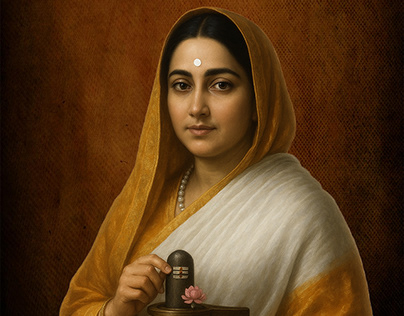
Her own family life continued to be marked by loss. Her son Male Rao died in 1767, within about a year of succeeding his grandfather. Her daughter Muktabai survived her into adulthood. Ahilyabai never remarried, and for the whole of her public life she appears in the record — and in every surviving representation of her — in the plain white dress of a widow.
Her path to leadership
The transition from widow of the household to head of the state happened over roughly two years, and in four identifiable moves.
A household already governing
By the time Ahilyabai was widowed she had spent two decades inside a working administration. The Holkar establishment was not a ceremonial court: it collected revenue, settled disputes, maintained troops and corresponded with the Peshwa at Pune. Accounts indicate that Malhar Rao Holkar involved his daughter-in-law in this business directly.
Two successions in two years
Malhar Rao Holkar died in 1766. His grandson — Ahilyabai’s son Male Rao — succeeded him and died the following year. In the space of roughly twelve months the state lost both the man who had built it and the young heir who was to continue it.
A claim made formally
Rather than allow the administration to pass to a regent or to be absorbed by rival interests, Ahilyabai sought and obtained recognition of her authority to govern the Holkar territories. The arrangement she then established separated civil administration, which she retained, from military command, which was exercised by Tukoji Rao Holkar.
A capital of her own choosing
She moved her seat to Maheshwar on the Narmada. It was a deliberate act: a working capital placed on a sacred river, at a distance from the older military centre, and shaped over the following decades into an administrative, religious and commercial town.
A note on sources. Dates for the events of 1766–67 are consistent across most accounts, but the precise legal and political mechanics by which Ahilyabai’s authority was recognised are described differently in different sources. This site sets out the broadly agreed sequence and avoids asserting detail that the record does not settle.
Challenges and responsibilities
A ruler in her position faced pressures from several directions at once. Internally, there was the question of whether her authority would be accepted — by the state’s own officers, by its troops, and by neighbouring powers who might read a disputed succession as an opening.
Externally, the Holkar state sat inside a Maratha confederacy that was itself under strain after 1761, and within reach of powers with their own designs on Malwa. Maintaining an army without allowing it to become the government, and maintaining the Peshwa’s recognition without surrendering practical independence, were both continuous problems.
Then there was the ordinary substance of government: revenue assessment and collection in a largely agricultural economy, the administration of justice, the safety of roads and trade routes, relations with forest and hill communities on the state’s margins, and the upkeep of everything already built.
Her answer to the first of these problems is the most instructive. By separating military command — exercised by Tukoji Rao Holkar — from civil authority, which she kept, she created a division of responsibility that lasted for the whole of her rule. It is a practical arrangement rather than a theoretical one, and it held.
Leadership philosophy
No treatise on government by Ahilyabai Holkar survives, and it would be wrong to invent one for her. What can be said is what her administration consistently did, across nearly three decades, and a clear set of priorities emerges from that.
A ruler who is willing to hear the smallest case in person has already decided what government is for.
The first priority was accessibility. She is described, consistently and from several directions, as holding open court and hearing petitions herself rather than delegating them. For a subject of an eighteenth-century Indian state, the difference between a grievance heard by a clerk and one heard by the ruler was the difference between a formality and a remedy.
The second was continuity. Her public works were characteristically paired with endowments intended to maintain them — land or revenue settled on a temple, a rest-house or a water source so that it would go on functioning. Building something and then funding its upkeep is a distinct administrative habit, and it is visible throughout her record.
The third was restraint in her own establishment. She is uniformly described as living simply and as drawing a firm line between the revenues of the state and her personal resources — with a number of her endowments funded from the latter.
Why her legacy continues to matter
Administration as the substance of rule
Her reputation does not rest on conquest. It rests on revenue handled carefully, disputes heard promptly, and public works completed and then endowed so that they would keep running. That is an unusual basis for lasting fame, and a durable one.
Patronage beyond her own borders
A very large share of the building associated with her name lies outside the territory she governed. It made her a figure of subcontinental standing at a time when her state was one of several within a larger Maratha structure.
A record that can be examined
Because so much of what she did took physical form — temples, ghats, wells, rest-houses — her rule can be studied through evidence that is still standing, rather than only through chronicle and tradition.
She died at Maheshwar on 13 August 1795 and was succeeded by Tukoji Rao Holkar. The state she left was solvent, its capital was a working town, and a very large number of the structures she had paid for were — and remain — in daily use.
Explore what she built
From the administration of a state to a programme of building that reached across the subcontinent.